
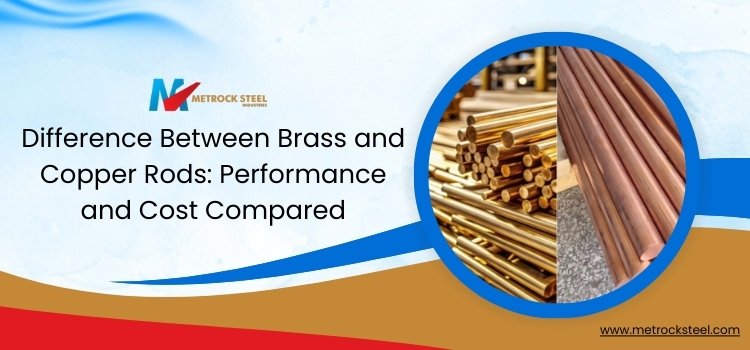
Brass vs Copper Rods: Which One Fits Your Project?
Choosing between brass and copper rods affects more than material cost, it shapes electrical performance, mechanical durability, and long-term maintenance across construction, plumbing, and industrial electrical work. Both are non-ferrous metals used heavily in copper rod and brass applications, but they behave very differently once installed. This guide breaks down the difference between brass and copper rods across conductivity, strength, corrosion resistance, and cost, so engineers, contractors, and procurement teams can match the right material to the right job.
Copper Rods: Key Characteristics
Copper rods are manufactured from high-purity copper and are prized for electrical and thermal performance. They’re the standard choice wherever conductivity, not mechanical strength, is the priority.
Performance Properties of Copper Rods
- Near 100% IACS electrical conductivity, the industry benchmark against which all other conductors are measured.
- High thermal conductivity, suited to heat dissipation applications.
- Good corrosion resistance in most atmospheric and water conditions.
- High ductility, allowing easy bending and shaping without cracking.
The tradeoff: copper is comparatively soft. In applications with repeated mechanical load or wear, it isn’t the first choice.
Brass Rods: Key Characteristics
Brass rods are a copper-zinc alloy, typically with 5–40% zinc content depending on grade, sometimes with small additions of lead or other elements to fine-tune machinability. That alloying is what gives brass its distinct balance of strength and workability.
Performance Properties of Brass Rods
- Moderate electrical conductivity, generally in the 25–40% IACS range depending on alloy grade, enough for many general-purpose uses, but well below copper.
- Higher mechanical strength and hardness than pure copper.
- Excellent machinability, which reduces fabrication time and tooling wear.
- Strong corrosion resistance, particularly in plumbing and marine-adjacent environments.
Brass vs Copper Rods: Side-by-Side Comparison
| Property | Copper Rods | Brass Rods |
|---|---|---|
| Electrical Conductivity | ~100% IACS | ~25–40% IACS |
| Mechanical Strength | Lower, soft, ductile | Higher, harder, more wear-resistant |
| Machinability | Moderate | Excellent |
| Corrosion Resistance | Good in atmospheric conditions | Strong, including plumbing/marine use |
| Typical Cost | Higher, tracks global copper prices | Lower, zinc content reduces material cost |
| Best Suited For | Earthing, power transmission, busbars, electrical connectors | Fittings, fasteners, architectural and mechanical components |
Conductivity: Where Copper Wins
For any application where electrical efficiency matters, grounding systems, busbars, transmission components, copper rods are the clear choice. Brass’s lower conductivity, generally 25–40% IACS depending on the specific alloy, makes it unsuitable for high-current work, though it performs adequately in low-current or non-critical circuits.
Mechanical Strength: Where Brass Wins
Copper’s ductility is an advantage for forming and shaping, but a limitation under sustained mechanical load. Brass rods hold up better to repeated stress, wear, and compression, which is why they dominate in fittings, fasteners, and structural or mechanical components rather than pure copper.
Cost Considerations
Copper pricing tracks global commodity markets and tends to run higher, especially during periods of copper price volatility. Brass, with its reduced copper content, is generally the more budget-friendly option, a relevant factor for large-scale procurement where conductivity isn’t the deciding requirement.
Which Rod Should You Choose?
Choose Copper Rods For:
- Earthing systems and electrical grounding
- Power transmission components
- Busbars and electrical connectors
Choose Brass Rods For:
- Plumbing fittings and valves
- Architectural and ornamental elements
- Fasteners, bolts, and mechanical parts
Conclusion
The difference between brass and copper rods comes down to a straightforward tradeoff: copper leads on conductivity, brass leads on strength, machinability, and cost. Matching the material to the application, rather than defaulting to one or the other, is what keeps both performance and budget on track for construction, electrical, and industrial projects.
FAQs
Q1. Which is better for electrical applications, copper rod or brass rod?
Copper rods are the better choice for electrical work due to their near-100% IACS conductivity, making them ideal for grounding systems, power transmission, and electrical connectors. Brass rods conduct electricity too, but at a much lower rate, limiting them to low-current or non-critical applications.
Q2. Are brass rods stronger than copper rods?
Yes. Brass rods generally offer higher mechanical strength and better wear resistance, making them well suited to fittings, fasteners, and structural parts. Copper rods are softer and more ductile, which makes them easy to form and shape but less suitable for load-bearing applications.
Q3. Why are brass rods cheaper than copper rods?
Brass contains zinc alongside copper, which lowers the overall copper content and reduces material cost. Since copper prices fluctuate with global commodity markets, pure copper rods tend to cost more, making brass a practical, lower-cost alternative where high conductivity isn’t required.
Ready to choose the right material for your project?
Whether you need high-conductivity copper rods or durable, cost-efficient brass components, our team can help you specify the right grade for your application. Contact us today or email us at sales@metrocksteel.com for expert guidance and reliable material solutions.