
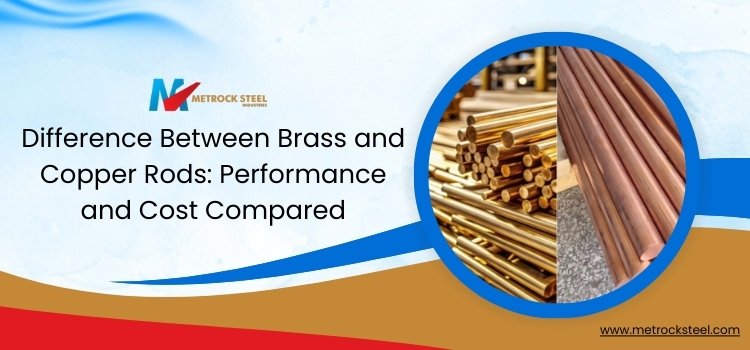
Understanding the Difference Between Brass and Copper Rods in Modern Construction and Engineering
The materials used in the current construction, infrastructure, and heavy engineering industries are critical in determining the performance, durability, and cost of the project at large. The relatively popular non-ferrous metals are brass and copper rods, which are usually compared in terms of the frequency of their use in electrical systems, plumbing, architectural features, and parts of industries. What is the difference between brass and copper rods? To match technical factors and cost constraints, construction heads, architects, and contractors should know what is implied by the Difference Between Brass and Copper Rods: Performance and Cost Compared.
Even though brasses and copper rods might seem similar to the naked eye, the internal structure of the material provides a substantial difference in conductivity, mechanical strength, corrosiveness, machinability and cost. Copper rods are very much electrical and thermal conductive, whereas the brass rods, which are an alloy of copper and zinc are very strong and highly machinable. This paper briefly discusses the performance nature and cost considerations of the two materials, and this discussion will assist the decision-makers in the industry to select the correct material to use in a particular application.
What Are Copper Rods and Their Key Characteristics?
Copper rods are made of high-purity copper, and they are highly rated in terms of their good electrical and thermal conductivity. They are mainly utilized in the transmission of power, grounding, and electrical parts.
Performance Properties of Copper Rods
Copper rods are more desirable in a situation where conductivity is important since they have the following advantages:
- Very large electrical conductivity, nearly 100% IACS.
- Superior thermal conduciveness, perfect for heat loss.
- Material has good corrosion resistance, particularly in atmospheric conditions.
- High ductile, and can therefore be bent and shaped easily.
Nevertheless, copper rods are not very hard, and this may be an impediment when mechanical strength is required.
What Are Brass Rods and Why Are They Used?
Brass rods are alloys of copper and zinc, which contain traces of other elements that are used to improve certain properties. Because of this combination, the brass rods have a good balance between strength, durability and workability.
Performance Properties of Brass Rods
Brass rods are conspicuous in both structural and decorative use because they offer:
- Intermediate conductivity, not as good as copper, but good enough in most applications.
- Greater mechanical strength as compared to pure copper.
- Excellent machinability, less fabrication time and cost.
- Excellent corrosion property, especially in marine and plumbing applications.
Since they have these advantages, brass rods have been extensively applied in fittings, fasteners, architectural details and mechanical components.
Brass vs Copper Rods: Conductivity Performance Compared
In electrical usage, conductivity is a factor that is commonly used to make the difference between brass and copper rods.
Key Differences in Conductivity
- Copper rods are superior in terms of electrical conductivity and hence can be used in electrical wiring, earthing and busbar.
- The conductivity of brass rods is lower than that of copper, some 25-35% of copper, which restricts their application in high current systems.
Application of secondary keys: Copper rods are obviously better than brass rods in projects that require high levels of electrical efficiency and low levels of energy loss.
Mechanical Strength and Durability Comparison
Mechanical strength is another factor of the essence of the Difference Between Brass and Copper Rods: Performance and Cost Compared.
Strength and Wear Resistance
- Copper rods are more ductile and softer, and can be made into various shapes, but cannot be used as load-bearing parts.
- Brass rods are stronger and harder, and they are suited for mechanical and structural parts.
Repeated stress on brass rods also exhibits increased wear and deformation resistance, which is helpful in the construction and industrial machinery.
Cost Comparison: Brass Rods vs Copper Rods
The biggest consideration in large-scale projects to be run by contractors and construction heads is cost.
Pricing Factors to Consider
- The expense of copper is usually higher because of the high percentage of copper and the world copper price fluctuation.
- Brass rods are more cost-efficient since zinc reduces the total cost of the material.
Budget-wise, there are times when brass rods are selected when the level of conductivity is not of great importance, and thus minimizes the overall cost of the project.
Application-Based Selection: Which Rod Should You Choose?
The decision of whether to use brass or copper rods does not necessarily rely on the price or strength but on the way it is going to be used.
Typical Applications of Copper Rods
- Earthing Systems and electrical grounding.
- Components of power transmission.
- Electrical busbars and electrical connectors.
Typical Applications of Brass Rods
- Freezes and other plumbing fittings.
- Elements architectural and ornamental.
- Nuts, mechanical parts, bolts, fasteners.
The use of this type of appliance-based approach is that the performance would be optimized at the same time being cost-effective.
Conclusion
Finally, the Difference Between Brass and Copper Rods: Performance and Cost Compared is in terms of conductivity, strength, and cost of the products. Copper rods are superior in their electrical and thermal conductivity, hence they cannot be ignored in power and electrical systems. On the contrary, brass rods are more mechanically strong, machinable and less expensive and, as such, are used in structural, plumbing, and architectural purposes. This knowledge of the differences will enable the heads of construction, architects, and contractors to make resourceful material decisions that are appropriate in terms of technical requirements and financial constraints.
FAQs
Q1. Which one is superior to use for electrical purposes, copper rod or brass rods?
The copper rods suit electrical purposes well since they are more highly electrically conductive. This renders them perfect for grounding systems, transmission of power and electrical connectors. Brass rods are also conductive, but have lower conductivity, which restricts their application to low-current or non-critical electrical parts. See approved electrical material standards of established electrical industry associations.
Q2. And are the brass rods more resistant than the copper ones?
Yes, normally, brass rods can be tougher in regard to mechanical strength and wear resistance. They work well at mechanical compression and reuse, so they are used in fittings, fasteners and structural parts. Copper rods are ductile and softer and this is well suited to forming, ng but is not well suited to load actions.
Q3. How come that brass rods are cheaper than copper rods?
The reason behind brass rods being less expensive is due to the addition of zinc to the already existing copper amounts, leading to less copper content. The prices of copper are volatile in the world market thus pure copper rods are more costly. A cost-effective alternative to brass rods, where high conductivity is not required, is the use of brass rods.
Ready to Choose the Right Material for Your Project?
Difference Between Brass and Copper Rods: Performance and Cost Compared matters when performance, durability, and budget are on the line.
Ready to make informed material decisions? Contact us today or email us at sales@metrocksteel.com to get expert guidance and reliable material solutions for your construction and engineering projects.