
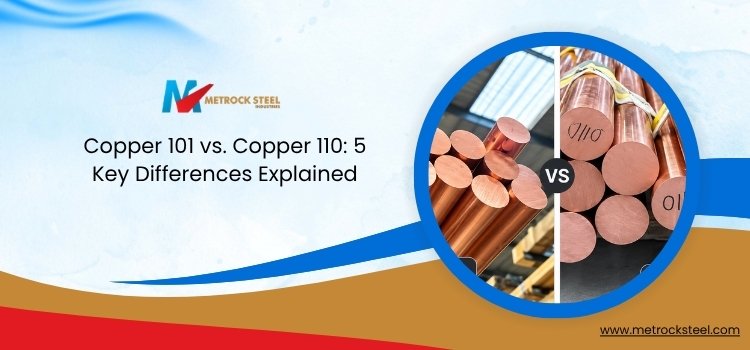
Two Pure Coppers, One Costly Mix-Up
Ask a supplier for pure copper, and you could receive either of two very different materials. Copper 101 and copper 110 look identical, bend similarly, and perform very similarly under current. Even so, they are not interchangeable.
Copper 101 is the shorthand designation for UNS C10100, an oxygen-free electronic (OFE) grade. Copper 110 refers to UNS C11000, known as electrolytic tough pitch (ETP) copper. The difference is tiny on paper but huge in price and performance.
This guide addresses the Copper 101 vs Copper 110 question with a simple answer. At the end, you’ll come to understand your project’s grade and when it doesn’t make sense to pay extra for purity.
Key Takeaways
- Copper 101 (C10100) is at least 99.99% copper with oxygen at 5 ppm or less.
- Copper 110 (C11000) is at least 99.90% copper and holds far more oxygen.
- Conductivity differs by only about 1% IACS, so most electrical jobs run fine on copper 110.
- Copper 101 earns its price in vacuum, semiconductor and high-temperature hydrogen environments.
What Is Copper 101 (C10100)?
Copper 101 is among the purest commercial coppers available. It holds a minimum of 99.99% copper, and its oxygen content stays at or below 0.0005%, or 5 ppm.
It is produced in a tightly controlled oxygen-free environment. That process removes the oxides that may form at grain boundaries and cause issues in critical service.
It is also available with a minimum conductivity of 101% IACS, per standard supplier datasheets.
What Is Copper 110 (C11000)?
Copper 110 is the common workhorse of the copper family. It is at least 99.90% copper, and the oxygen concentration is usually 200-500 ppm.
That small amount of oxygen is deliberate. It makes the metal tougher and easier to cast, and it’s less expensive to manufacture than oxygen-free grades.
The minimum conductivity is 100% IACS, and more C11000 is sold today at or above 101%. Both grades are covered by standard ASTM and UNS specifications.
Copper 101 vs. Copper 110 Difference at a Glance
The table below sums up the main points.
| Property | Copper 101 (C10100) | Copper 110 (C11000) |
| Copper content | 99.99% minimum | 99.90% minimum |
| Oxygen content | 5 ppm or less | About 200-500 ppm |
| Electrical conductivity | 101% IACS minimum | 100% IACS minimum |
| Hydrogen embrittlement | Resistant | Susceptible when heated in hydrogen |
| Cost | Higher | Lower |
Purity and oxygen content
Purity underpins all other differences. Copper 101 contains almost no oxygen, and copper 110 has enough to create minute copper oxide particles in the metal.
Conductivity
The copper 101 vs. copper 110 difference in conductivity is about one percentage point. That margin usually doesn’t change a design for wiring, busbars, and general power distribution.
Hydrogen embrittlement
This is the only major fabrication difference. If you heat copper 110 in a hydrogen-rich atmosphere, the hydrogen reacts with the oxygen inside and produces steam. The steam pressure can crack the metal.
Copper 101 has no oxygen to react with and therefore does not pose the same risk in reducing atmospheres for brazing and annealing.
Copper 101 vs. Copper 110 Applications
Every grade has a natural home, and the division is based on the purity gap.
Copper 101 is typically used where cleanliness and performance outweigh cost:
- Semiconductor manufacturing equipment and plasma deposition equipment
- Particle accelerators and vacuum devices
- Precision electronic conductors, radar components
- Cryogenic systems, where oxygen-free copper is widely used
Copper 110 covers the large, cost-sensitive territory:
- Busbars and electrical wiring
- Heat exchangers and other heat transfer parts
- Terminals, connectors and general fabrication
- Gaskets, roofing and architectural work
Learn more about related alloys in Metrock Steel’s metal and alloy guides.
Copper 101 vs. Copper 110 Uses: Which Should You Choose?
Start with the environment, not the spec sheet. Ask three questions.
- Will the part run in a vacuum or an ultra-clean process? Choose copper 101.
- Will it be brazed or annealed in hydrogen? Choose copper 101.
- Is it for standard electrical or thermal service? Typically, copper 110 is sufficient.
Buying C10100 for a routine busbar adds cost with almost no gain. C11000 is used in a hydrogen-brazed assembly, which can cause cracked parts and rework.
If you’re comparing other grades, our copper products fall within a good range.
Conclusion
There are two high-conductivity copper grades: copper 101 and copper 110, and they have different jobs. Copper 101 offers 99.99% purity, near-zero oxygen and resistance to hydrogen embrittlement. Copper 110 offers 99.90% purity, dependable conductivity and a lower price.
For most electrical and thermal work, copper 110 is the practical choice. For vacuum, semiconductor and hydrogen-exposed applications, copper 101 justifies its premium.
FAQs
Q1. Is copper 101 better than copper 110 for electrical wiring?
Not usually. Copper 101 performs approximately 1% less (IACS rating) than copper 110; therefore, copper 110 is the economical option for normal wiring and busbars.
Q2. What does C10100 vs. C11000 mean in practice?
C10100 is oxygen-free electronic copper (copper 101), and C11000 is electrolytic tough pitch copper (copper 110). The first is purer and more expensive, and the second is a more general grade.
Q3. Can copper 110 be brazed safely?
Yes, but not in a hydrogen-rich atmosphere. In hydrogen, the internal copper oxides will react to form steam, which can fracture the copper.
Need help selecting the right grade, or have questions about tolerances, lead times, or custom orders? Our team can support your decision and manage the quoting process.
Tell us your grade, size and quantity, and our team will respond with a quote.
Contact us: metrocksteel.com | sales@metrocksteel.com