
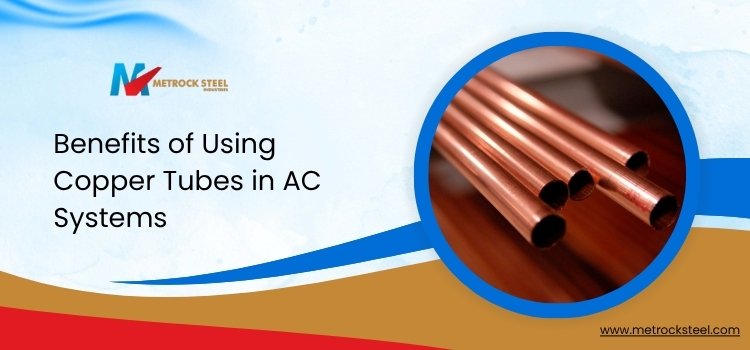
Why Copper Is Still the Industry Standard for AC Tubing
Refrigerant lines, coils, and heat exchangers all run through metal tubing that has to survive constant pressure cycling, temperature swings, and years of continuous use without leaking. Copper has been the default choice for this job for decades, and it’s still specified in the majority of new residential and commercial AC installations; not out of habit, but because no other commonly available material matches its combination of heat transfer, pressure tolerance, and serviceability. This guide breaks down the specific benefits of using copper tubes in AC systems, where copper actually beats the alternatives, and how to pick the right type for a given installation.
Core Advantages of Copper Tubes for Air Conditioning
- Exceptional Thermal Conductivity: Copper conducts heat roughly twice as efficiently as aluminum, which translates directly into faster heat exchange at the coil and lower compressor run time for the same cooling output.
- Pressure and Burst Resistance: Copper tube manufactured to ASTM B280 and IS 1993 standards is rated to handle the operating pressures of modern refrigerants, including higher-pressure options like R-410A, without the wall thinning that leads to bursts over time.
- Natural Corrosion Resistance: Copper forms a stable oxide layer on exposure to air, which protects it from most moisture and atmospheric corrosion — a key reason it’s used in coastal and high-humidity installations where aluminum coils corrode faster.
- Antimicrobial Surface Properties: Copper naturally inhibits the growth of bacteria and fungi on its surface, which matters for indoor air quality in systems where condensate sits on coil surfaces.
- Ease of Installation and Field Repair: Copper is ductile enough to bend and braze on-site, so technicians can route it around obstacles and repair a leak by cutting and rejoining a section — instead of replacing an entire coil, which is often the only fix for damaged aluminum tubing.
- Recyclability: Copper can be recycled without loss of performance, which supports end-of-life system disassembly and lowers the embodied-carbon footprint of copper-based HVAC equipment compared to composite or mixed-metal alternatives.
Copper vs. Aluminum: A Clear Winner for AC Pipes
Aluminum tubing shows up in some AC systems mainly because it’s cheaper by weight. In practice, that upfront saving is usually offset by higher leak rates and shorter service life. Here’s how the two compare on the factors that matter for a working system:
| Feature | Copper Tubes | Aluminum Tubes |
|---|---|---|
| Thermal Conductivity | ~401 W/m·K — roughly double aluminum’s rate | ~237 W/m·K — slower heat exchange |
| Connection Strength | Brazed or flared joints hold reliably under pressure cycling | Higher risk of joint fatigue and refrigerant leaks over time |
| On-site Reparability | Cut, braze, and rejoin in the field | Often requires full coil replacement |
| Lifespan & Durability | Typically 15–20+ years with proper installation | Shorter average lifespan; prone to galvanic corrosion where dissimilar metals meet |
How Copper Tubes Improve AC System Efficiency and Longevity
- Faster Cooling at Lower Energy Cost: Better heat exchange at the coil means the compressor reaches target temperature faster and cycles less, which shows up directly on the energy bill.
- Fewer Service Calls: Corrosion resistance and durable joints mean fewer refrigerant leaks — leaks are one of the most common reasons AC systems lose efficiency or fail early.
- Compact, Lighter Coil Design: Because copper is strong relative to its wall thickness, manufacturers can use smaller-diameter copper tubing without sacrificing pressure rating, which allows for more compact coil and unit designs — and lower refrigerant charge volumes.
Choosing the Right Copper Tube Type and Size
Selecting the correct copper tube isn’t just about wall thickness on paper — it depends on the application, operating pressure, and whether the run is exposed or buried:
- Type L: The default choice for most residential and commercial refrigerant lines. Balances wall thickness and flexibility, and is accepted under most local plumbing and HVAC codes.
- Type K: Thickest wall of the three; specified for underground refrigerant lines or high-pressure industrial applications where extra protection against damage or corrosion is needed.
- Type M: Thinner-walled and more economical; acceptable for some low-pressure residential lines, but check local code before specifying — some jurisdictions restrict Type M to specific applications.
For AC-specific applications with tighter tolerances, ACR copper tube is cleaned and capped to refrigeration-grade specifications, which reduces the risk of contamination inside a sealed refrigerant circuit. A full breakdown of wall thickness and use cases is in our Type L vs K vs M comparison guide.
Where Copper Tubes Are Used in an AC System
- Refrigerant lines connecting the indoor and outdoor units
- Condenser and evaporator coils, typically using finned copper tube for maximum surface area
- Heat exchangers
- Fittings and connectors joining sections of the refrigerant circuit
Conclusion
Copper’s combination of heat transfer, pressure tolerance, corrosion resistance, and field-repairability is why it remains the standard for AC refrigerant lines and coils, despite aluminum’s lower material cost. For most installations, the right approach is Type L or ACR-grade copper tube sized to the system’s pressure and application — Type K only where extra wall thickness is specifically required.
FAQs
Q1. What are the main benefits of using copper tubes in AC systems?
Superior heat transfer for better cooling efficiency, high burst resistance under refrigerant pressure, natural corrosion and antimicrobial resistance, and the ability to be repaired on-site rather than replaced.
Q2. Are copper AC pipes better than aluminum?
For most installations, yes. Copper offers roughly double the thermal conductivity of aluminum, stronger long-term joint reliability, and field repairability. Aluminum has a lower material cost but typically shows higher leak rates and a shorter service life, which often makes copper the better value over the system’s lifetime.
Q3. How long do copper tubes last in an air conditioner?
With correct installation and routine maintenance, copper refrigerant tubing typically lasts 15–20 years or longer.
Q4. What’s the difference between Type L, K, and M copper tube for AC use?
Type K has the thickest wall and is used for underground or high-pressure runs; Type L is the standard choice for most residential and commercial refrigerant lines; Type M is thinner and more economical but has more code restrictions on where it can be used.
Looking for a reliable copper tube manufacturer in India? Our team can help you select the right type, wall thickness, and diameter for your HVAC application. Email sales@metrocksteel.com or contact Metrock Steel for technical guidance and a quote.