
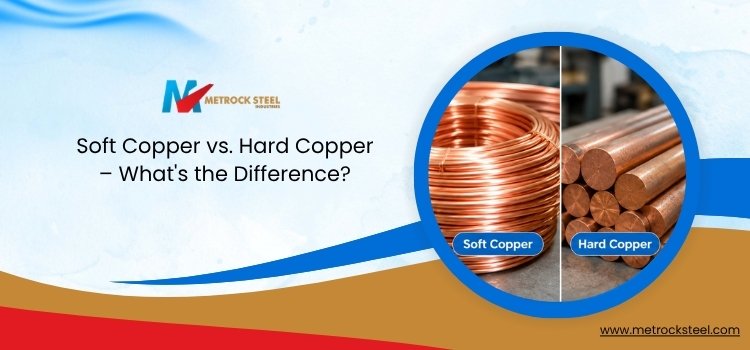
Understanding Soft Copper vs. Hard Copper
Walk into any plumbing supply shop and you’ll see copper tubing sold two ways: coiled in rolls, and in straight, rigid lengths. That difference is called temper, and it is the first real choice between soft copper vs. hard copper.
Both come from the same base metal. They differ in how they are finished, which affects bending, strength and where each one belongs on the job. The wrong temper can add joints, add solder points, or leave you with a line that simply won’t fit.
This guide explains the difference between soft and hard copper, what the standards call each temper, and how to choose between them.
Key Takeaways
- Temper, not composition, separates soft and hard copper.
- Soft copper is annealed (heat-treated) and flexible. Hard copper is drawn and stiff.
- Soft copper suits tight bends and long coiled runs. Hard copper suits exposed, straight runs.
- Fewer joints on winding runs means fewer places for a leak.
- Brazing softens hard tube near the joint, so fitting pressure ratings assume annealed tube.
- The right choice depends on the application, not a blanket preference.
Soft Copper Properties: Why It Bends So Easily
Soft copper, or annealed copper, is a flexible copper that is made through a heat-treatment process. Once drawn into tube or wire, the copper is heated and gradually cooled to relieve strain from the drawing process and relax the internal grain structure. If handled properly, the resulting metal can be hand-bent or bent with a simple bending tool without cracking or kinking.
Among Soft Copper Properties worth noting for job-site decisions:
- Available in coils typically up to 60-100 feet in length, not just cuts.
- More freeze-thaw resistant than hard-drawn tube, allowing it to flex slightly under pressure.
- Requires fewer fittings on long or winding runs, which reduces potential leak points
- Lower tensile strength than hard copper, so it’s not the choice for exposed, load-bearing runs
Hard Copper Properties: Strength Without the Flex
Hard copper is also known as drawn or hard-drawn copper, and does not undergo that final annealing step. It keeps the strength and rigidity it picked up during the cold-drawing process that shapes the tube or wire in the first place. That is why it stays straight when hung alone and doesn’t sag or bow out over an extended span like soft copper can.
Key Hard Copper Properties include:
- Tubing comes in hard, straight lengths, usually up to 20 feet.
- Improved tensile strength for use in exposed runs and load-bearing installations.
- Holds its shape without extra support, useful in mechanical rooms and visible plumbing.
- Harder to bend on-site, which usually means more elbow fittings on runs with turns
Soft Copper vs. Hard Copper: A Side-by-Side Look
| Factor | Soft Copper | Hard Copper |
|---|---|---|
| Form | Coiled rolls | Straight rigid lengths |
| Typical length | Coils up to about 100 ft | Straight lengths up to 20 ft |
| Standard temper (ASTM B88) | Annealed, O60 | Drawn, H58 |
| Types available | K and L (Type M not sold in rolls) | K, L, M and DWV |
| Flexibility | Bends by hand or with a bender | Rigid, difficult to bend |
| Strength | Lower tensile strength | Higher tensile strength |
| Joints needed | Fewer on long runs | More on runs with bends |
| Best suited to | Concealed, winding, long runs | Exposed, straight, load-bearing runs |
Soft Copper Applications on the Job
Soft copper is a must-have where a run has to bend around obstacles, but doesn’t have a fitting every time. Refrigerant lines in split AC systems are a common example, since the tubing has to snake from an outdoor condenser to an indoor unit through walls and tight framing cavities. It is also a popular option for underground water service lines because it eliminates the need for joints that must be replaced later.
Soft copper is also common in electrical systems as a grounding wire because it is flexible enough to route around objects easily, and in appliances that need a bit of give to compensate for vibration.
For a closer look at how this plays out in cooling systems, see our post on why copper tube is used in refrigeration systems.
Hard Copper Applications Where Rigidity Matters
For plumbing runs visible within residential and commercial buildings, straight lines are the rule and require exposed, clean-painted pipework that doesn’t sag. Also a must-have for main water supply lines, HVAC piping in mechanical rooms, and overhead electrical power transmission wire where strength under its own weight matters more than bending.
Often, Hard Copper Applications involve exposed installations, and the technician will carefully size and cut each section before soldering, as there’s little room to adjust once the piece is fitted straight. If you’re doing that, check out our article about how to cut copper pipe in a tight space, where you’ll learn how to make clean and leak-free cuts in tight spaces.
Making the Right Choice for Your Project
Neither temper is “better”; it depends on the run. Hard copper provides rigidity to a short, exposed, straight section in a mechanical room. Soft copper’s flexibility is required along the long, winding line of refrigerant through framing cavities. Many jobs require both hard copper for visible runs and soft copper for runs routed around structural obstacles.
It’s also a good idea to double-check your system’s pipe sizing before ordering. Our guide on how to measure copper pipe size walks through getting that measurement right the first time.
Conclusion
The difference between soft copper and hard copper is mainly temper, not quality. Soft copper is flexible and works well in long, winding, or concealed applications, while hard copper, which is drawn, is stronger and most often used in exposed, straight, load-bearing applications. Understanding the properties of Soft and hard copper, and the typical applications of each temper, should make specification easier the next time a job requires copper tube or wire.
FAQs
Q1. Can soft copper be used for the same applications as hard copper?
Sometimes. Soft copper can replace hard copper on many plumbing runs, but it has lower strength, so it isn’t suited to exposed, unsupported spans. Fitting pressure ratings are based on annealed tube, so check the rating for your tube type, size and temper before you substitute.
Q2. Does soft copper need more fittings than hard copper?
Usually fewer, not more. Because soft copper bends around corners without a joint, long or winding runs often need fewer fittings than the same run in hard copper.
Q3. Is soft copper weaker than hard copper?
Yes, in terms of tensile strength. The annealing process that makes soft copper flexible also reduces its strength compared to hard-drawn copper, which is why hard copper is preferred for exposed or structural runs.
Q4. Can soft copper be used for underground water lines?
Yes, soft copper is widely used for underground water service lines because of its flexibility and corrosion resistance. It can be coiled to reduce the number of joints needed, minimizing potential leak points.
Q5. What is the typical length for soft copper coils?
Soft copper is commonly sold in coils of up to 100 feet, depending on diameter and type. Type M is generally not sold in rolls.
Metrock Steel Industries manufactures and supplies copper pipe, tube, and fittings in both soft and hard tempers for plumbing, HVAC, and industrial applications. Contact our teamor email sales@metrocksteel.com to find the right grade and temper for your job.