
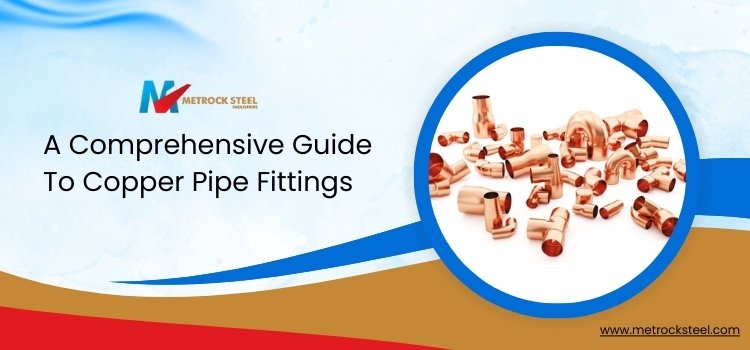
Understanding the Importance of Copper Pipe Fittings in Modern Systems
Copper Pipe Fittings are used in residential plumbing designs as well as large-scale commercial plumbing systems. They have been described today as one of the most trusted in the transportation of water, gas, and HVAC fluids, and are therefore essential in the construction, architecture, and development of infrastructure. This A Comprehensive Guide To Copper Pipe Fittings discusses how the components contribute to the performance, safety, and efficiency of both small and large projects.
Types of Copper Pipe Fittings Used in Plumbing Systems
There are various Copper fittings, which are necessary in different installations, and each one has a purpose. The most familiar ones are as follows:
1. Elbows
- Install to turn the pipe.
- Available in 45° and 90°
- Fits well in narrow construction designs.
2. Couplings
- It was used to connect two straight pipes.
- They come in standard, slip, and reducing couplings.
3. Tees
- Allow a member of a pipe to bifurcate.
- Applicable in plumbing systems of more than one outlet.
4. Reducers
- Link pipes of various dimensions.
- Ensure a smooth flow and decrease the diameter.
5. Caps and Plugs
- Seal pipe ends
- Comes in handy when there is testing or any future expansions.
These alternatives illustrate why copper pipe fittings are still necessary to construction professionals and contractors who need a steady performance that is leak-free.
Why Copper Plumbing Fittings Matter for Construction and Architecture?
Large-scale commercial environments need no better method of copper plumbing fittings that are very reliable. They are still preferred by construction experts due to their ability to offer:
- Corrosion and scaling resistance.
- Capacity to stand high temperatures.
- Simple maintenance and installation.
- Interoperability with other mechanical systems.
This renders Copper fittings particularly useful in commercial structures, hospitals, factories, high-pressure water structures, and HVAC structures.
Advantages of Using Copper Pipe Fittings
The benefits of copper are particularly effective in the case of complex construction systems. Benefits include:
- Durability: Even under severe conditions, copper fittings last for decades.
- Heat Resistance: Fits perfectly in the HVAC, hot water, and industrial systems.
- Leak-Proof Construction: Fittings are sealed by soldering, brazing, or using press fittings.
- Versatility: Copper can be used in various applications, from gas lines to chilled water.
- Low Maintenance: The wear is minimal with time, thus it is cost-effective in long-term projects.
Employing copper pipe fittings at 2,3 times is inherently used to provide a stronger integrity to the systems, and secondary keywords such as copper plumbing fittings, types of copper pipe fittings, and copper plumbing solutions are used to direct the construction professionals in making the correct decisions.
How to Choose the Right Copper Pipe Fittings for Your Project?
The choice of the right fittings can be very significant in performance and safety.
Key considerations:
- System requirements: temperature, pressure, and fluid type.
- Pipe size compatibility
- Fitting material grade
- Installation procedure (soldering, brazing, press, compression)
- Maintenance of long-term and short-term budgets.
Applications of Copper Pipe Fittings Across Industries
Fittings made of copper are believed to be reliable in many industries, such as:
- Commercial plumbing systems
- HVAC units
- Fire protection pipelines
- Industrial fluid handling
- Water supply systems in residential houses.
- Medical gas systems
All these extensive applications depict the extent to which copper plumbing fittings are invaluable to architects, contractors, and the heads of construction when it comes to designing infrastructure that is long-lasting.
Conclusion
We discussed the most significant issues of copper pipe fittings in this guide, such as their types, benefits, uses, and the process of selecting the appropriate components. The elbows, tees, and reducers, or the couplings, each of them fitting, contribute to the efficiency and stability of the system. Copper fittings can be used in the design of a commercial system of HVAC and in the construction of a multi-storey building that needs to be reliable and durable to last long.
FAQs
Q1. What are the most popular copper pipe fittings of commercial plumbing systems?
Common copper fittings, such as elbows, tees, couplings, and reducers, can be found because they can support the complex layout of pipes.
Q2. Can copper plumbing fittings be used in high-temperature uses?
Yes, copper fittings are resistant to heat, and so are best used with boilers, HVAC, and in hot water pipelines.
Q3. What is the average life of copper pipe fittings in building installations?
Copper fittings will also withstand several decades in the case of a proper installation due to their resistance to corrosion and structural integrity.
Choose premium copper plumbing fittings for superior performance and reliability. Contact us today or email your request to sales@metrocksteel.com to get expert guidance for your next big project.